
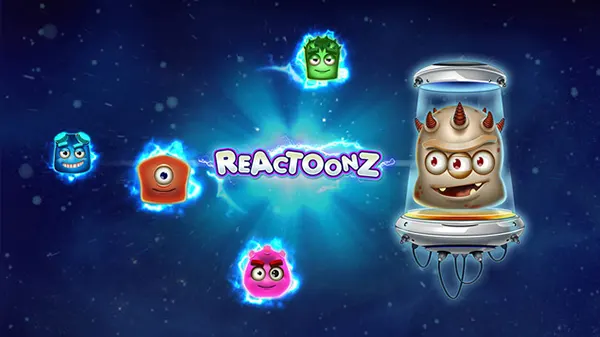
Reactoonz (Play’n GO) in 2026: avalanches, Quantum charging, and how the bonus really works
Reactoonz is one of those slots that feels simple until you look closely: a 7×7 grid, wins that come in clusters, and a “Quantum” meter that can suddenly unleash multiple features. What catches many players out is the order in which everything resolves. Once you understand what triggers a chain, what actually fills the meter, and when features fire, the game becomes far easier to read—without falling into the usual “it’s due” myths.
The base game loop: cluster wins and why one spin can last so long
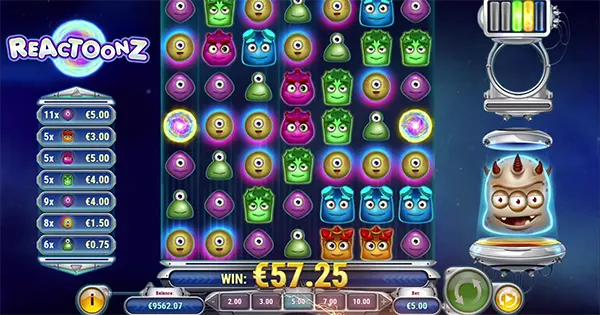
Reactoonz uses cluster pays rather than paylines. Instead of lining symbols up across fixed lines, you win when five or more matching symbols touch horizontally or vertically on the 7×7 grid. When a cluster pays, those symbols disappear and new ones drop in from above, which can form another cluster in the same paid spin.
This “avalanche” (or cascade) behaviour is not a separate bonus feature—it is how the game resolves wins. A single paid spin can contain several win checks in a row, because each new drop is evaluated again. That’s why Reactoonz often feels busy even when the cash results are small: there can be movement and multiple mini-wins without any meaningful uplift.
The key point is that avalanches are a win-resolution mechanic, not a sign the slot is “warming up”. You can have many spins with short chains and minimal return, then suddenly hit a long chain that changes the entire session’s outcome. That uneven pattern is normal for a high-volatility title.
How to read the grid like a mechanic, not a superstition
Focus on cluster size rather than animation. Minimum wins start at five connected symbols, but larger clusters clear more space, which increases the chance that the next drop creates new clusters. If you repeatedly see tiny clusters, you’re typically in low-impact chains. When you see bigger clears, the grid has more room to reshuffle into something meaningful.
Also watch “near clusters”. Groups of four touching can turn into paying clusters with only one favourable symbol landing nearby. You can’t influence what drops, but you can recognise when the grid is structured in a way that makes follow-up wins more plausible. This is observation, not a strategy that guarantees results.
Finally, notice how abruptly a chain ends. The spin stops as soon as no qualifying clusters remain. That stop matters because meter-related progress is tied to what happens inside a continuous chain. When the chain dies, players often feel the game “robbed” them of a feature—but it’s simply the rule set doing what it always does.
Quantum charging explained: what fills the meter and what it actually “rewards”
The Quantum meter is designed to reward consecutive winning activity inside a single avalanche chain. In practical terms, the game is looking at how many winning symbols are removed during that chain, not just how many times you win. Small clusters may barely move the meter, while one large clear can make a visible jump.
When the meter reaches its requirement, it adds a Quantum feature to a queue. The important detail is the word “queue”: the game can store multiple features and release them in sequence. That’s why Reactoonz can swing from a calm base round into a sudden chain of feature activations that completely reshapes the grid.
Most confusion comes from treating the meter as if it’s owed to you over time. It isn’t. The meter is tied to uninterrupted win chains. Long sessions don’t guarantee progress, and a run of dead spins can repeatedly break the kind of chain you need to build up to features. If you remember only one thing, remember this: the meter reflects what just happened—it does not predict what must happen next.
The four Quantum features: what they do and what they don’t promise
Reactoonz can trigger four Quantum features, each designed to reshape the grid in a different way. Broadly, they either create wilds, change symbol types, cut patterns across the grid, or clear certain symbols to open space. The goal is always the same: increase the chance of forming new clusters after the reshuffle.
These features can look dramatic, but they are not “win buttons”. Their value depends on what the grid looks like at the moment they fire. Sometimes they set up a long avalanche chain and feel incredible. Other times they simply rearrange the board and the spin ends quickly. That variance is part of the game’s character.
If you want a practical way to judge a feature’s impact, ignore the visual flair and watch the follow-up: does it create larger clusters, multiple consecutive clears, and extended avalanches? That is where the money is made, not in the feature animation itself.
2026 reality checks: RTP variants, volatility, and healthier session control
In 2026, one of the most important “real world” details about many online slots—including Reactoonz—is that RTP can vary depending on the operator’s configuration. The same title may exist in different RTP profiles, and the version you play can be lower than what you’ve seen quoted elsewhere. If the casino provides an information panel or rules screen showing RTP, it’s worth checking rather than assuming.
Reactoonz is generally experienced as high volatility. In plain English, that means results can be uneven: many sessions will have modest returns and long dry spells, while a smaller number of sessions are shaped by rare but powerful chains where features stack and the grid keeps paying. If your bankroll plan relies on steady, frequent wins, the design of this game will likely feel uncomfortable.
The safest way to approach a volatile slot is to treat it like entertainment with hard boundaries. Decide your stake based on what you can comfortably lose, set a strict spend cap, and choose a stopping point that isn’t dependent on “just one more feature”. If the Quantum meter and near-miss feelings start pushing you into chasing behaviour, that’s the exact moment to take a break.
How to avoid the most common myths players still repeat in 2026
Myth one: “The meter is due.” The Quantum bar does not create obligation. It reflects progress inside win chains. If you keep getting short chains, it will often hover near completion without delivering, and that is not evidence of a coming payout.
Myth two: “Demo results equal real-money results.” A demo is useful for learning mechanics and visuals, but it cannot prove how your session will go in a particular casino build. Variance is real, and RTP settings can differ. Treat demos as training, not forecasting.
Myth three: “There’s a trick to force Quantum features.” There isn’t. You cannot control symbol drops, and you cannot time spins to influence outcomes. The only “skill” available is understanding the sequence: clusters pay → avalanches continue while wins exist → the meter builds from winning symbols in the chain → queued features reshape the grid and may extend the chain. Once you follow that logic, the game becomes clear—even when it remains unpredictable.
-
 Signs of an Unreliable Online Casino: A Pr...
Choosing an online casino in 2025 is no longer just …
-
 Wild Cash x9990 Slot Review
Wild Cash x9990 is a remarkable addition to the online …
-
 Dwarf & Dragon Slot Game Review
The Dwarf & Dragon slot game, developed by an innovative …
-
 Don Juan Peppers by Evoplay — A Festive Me...
Evoplay has introduced a colourful slot called Don Juan Peppers, …