

Responsible gambling in casinos: what limits, time-outs and self-exclusion really do (2026)
Responsible gambling tools are often described as “safety features”, but they are only effective when you understand what they can and cannot change. In 2026, most licensed casinos offer account limits, session reminders, cooling-off breaks, and formal self-exclusion routes. Some countries also run national self-exclusion registers that block access across all licensed operators. The point is not to moralise gambling, but to reduce preventable harm by adding friction, time, and clear boundaries when emotions and chasing start to take over.
Limits: useful boundaries, not a guarantee
Account limits work best when they are simple, specific, and hard to “negotiate” in the moment. Deposit limits are usually the most practical because they cap the money entering your gambling balance. Wager limits can reduce intensity, but they do not necessarily reduce total losses if play simply lasts longer. Loss limits can be psychologically tricky: once you hit the limit, you may feel you have “permission” to lose up to that number, which can normalise spending rather than control it.
A realistic limit is based on disposable money, not on what you hope to win back. A clean method is to decide a weekly or monthly entertainment budget, then set a deposit limit below that figure so you have a buffer for mistakes. If your casino allows it, set the limit to apply immediately for decreases (tightening), while increases should take time to activate. The delay matters because it separates a calm decision from an impulsive one.
Limits also have blind spots. They usually apply to a single account, so they do not stop you opening an account elsewhere unless the country has a central system. They also do not stop cash withdrawals, borrowing from friends, or using alternative payment methods. In practice, limits are strongest when paired with bank gambling blocks, fewer available payment options, and a clear rule that gambling money never comes from rent, food, bills, or debt repayments.
How to set limits that actually hold up under pressure
Start with the behaviour you want to prevent. If your problem is long sessions, a deposit limit alone will not fix it; you also need time-based controls. If the issue is “just one more top-up”, then a strict deposit limit is your best first move. Choose one primary limit, set it lower than you think you need, and treat it as non-negotiable for at least one month so you can see how often you try to override it.
Use “friction” on purpose. Remove saved cards, do not store payment details, and switch off one-click deposits. If your bank supports gambling transaction blocks, enable them and set a personal rule that you will not ask the bank to lift the block during the same month. This is not about shame; it is about designing your finances so an impulsive click cannot become a larger loss spiral.
Finally, track the signals that limits are failing. If you regularly hit the cap, feel anger at the tool, or immediately look for another operator, that is not “bad discipline”; it is a sign you need a stronger boundary. In that situation, moving from limits to a formal time-out or self-exclusion is often more effective than repeatedly adjusting numbers.
Time-outs: a circuit breaker for chasing and fatigue
A time-out (sometimes called a cooling-off break) is designed to stop play for a short period when you sense control slipping. The key benefit is psychological: it interrupts the loop of rapid decisions, losses, and urgent attempts to “fix” the session. Even a 24-hour break changes the situation because it forces you to sleep, eat, and return to the decision with a clearer head.
Time-outs are most useful when the harm comes from intensity rather than from occasional spending. They help with late-night play, fast games, and emotional gambling after stress or alcohol. They also reduce “tilt”, where frustration leads to bigger stakes and riskier choices. Unlike limits, a time-out targets the moment when judgement is most distorted.
However, time-outs are not a full barrier. Depending on the rules where you play, you may still be able to gamble elsewhere during the break, especially if you use more than one casino. That is why time-outs work best as part of a routine: decide in advance what you will do during the break (walk, call someone, watch a film, go to bed), and make gambling access harder with device blocking tools or account restrictions.
When a time-out is the right tool, and when it is not
A time-out fits when you can still recognise the warning signs: playing longer than planned, raising stakes to recover losses, feeling numb, or thinking about gambling while doing other tasks. If you can catch yourself early, a short enforced pause can prevent a bad evening turning into a damaging week. Treat it like stepping away from the table, not like “punishment”.
A time-out is not enough when you keep breaking your own rules across multiple days, when gambling is tied to debt, or when you repeatedly return immediately after each break ends. In those cases, you are not dealing with a single session problem; you are dealing with a pattern. A stronger intervention is usually needed, even if it feels inconvenient.
To make a time-out effective, plan the end-point as well as the start. Before the break ends, decide what “safe play” looks like next: a smaller deposit limit, fewer sessions per week, or no casino play at all for a set period. If you cannot set a realistic plan, consider moving straight to self-exclusion and seeking specialist support.
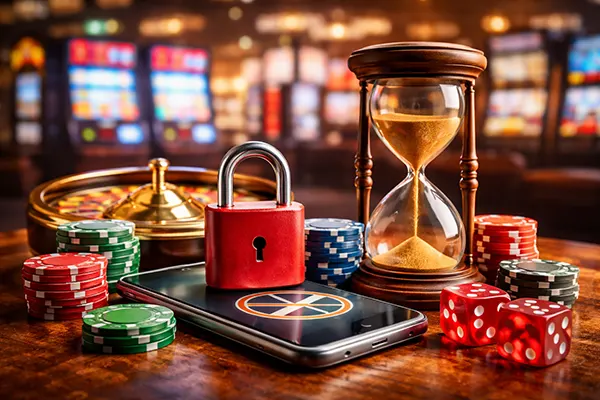
Self-exclusion: the strongest boundary, especially with national schemes
Self-exclusion is a formal agreement that blocks your access for a fixed period. It is meant for situations where you cannot reliably stop yourself, even with limits and breaks. Licensed operators are expected to take reasonable steps to prevent access during the exclusion period, and many jurisdictions encourage or require multi-operator schemes so one request can cover many brands.
In the UK, the Gambling Commission points people to multi-operator self-exclusion options, including GAMSTOP for online gambling. In 2026, GAMSTOP offers exclusions of 6 months, 1 year, 5 years, or “5 years with auto-renewal”, which rolls into another minimum period unless you switch it off. In Sweden, the official Spelpaus service allows exclusion for 1, 3, or 6 months, or “until further notice” with a minimum 12 months before it can be ended. In Denmark, the official ROFUS register excludes you from licensed online gambling and land-based casinos, with the option to choose temporary or permanent exclusion.
Self-exclusion is powerful, but it still has limits. It generally applies to licensed operators in that jurisdiction, not to unlicensed overseas casinos. It also does not automatically fix financial damage already done, and it cannot replace mental health or addiction support when gambling has become a coping mechanism. The most effective approach is self-exclusion plus practical barriers (blocking tools, bank blocks) plus real-world support.
What to expect after you self-exclude, and how to protect the gaps
Expect mixed emotions in the first days: relief, anxiety, and sometimes a strong urge to find a workaround. That reaction is normal, and it is exactly why self-exclusion exists. Make a short “gap plan” before you click confirm: who you will message when cravings spike, what you will do with free time, and how you will handle boredom or stress without gambling.
Close the loopholes you control. Install gambling blocking software on devices you use most, remove gambling apps, and turn off marketing emails and texts where possible. If you have a bank that supports gambling merchant blocks, enable them. If debt is involved, speak to a free debt advice service early; waiting usually makes the pressure worse, and pressure is a common trigger for relapse.
Finally, treat the end of an exclusion period as a risk point, not a finish line. If your life is calmer and gambling urges are lower, you can decide whether controlled gambling is realistic. If you feel nervous about access returning, extend the exclusion or keep auto-renewal in place. If gambling has harmed relationships, work, or finances, professional support is a sensible next step even if you feel “fine” on the surface.
-
 Skill-Based Games vs Luck-Based Games: Whe...
In 2025, the boundaries between skill-based and luck-based games have …
-
 Starburst XXXtreme rewiew
Fans of gambling have always associated Net Entertainment with quality …
-
 Thriving in the Digital Arena: Online Poke...
As the digital age progresses, traditional games, including the ever-popular …
-
 Jacks or Better Video Poker Game
Avid gamblers and casual players alike revel in the allure …