
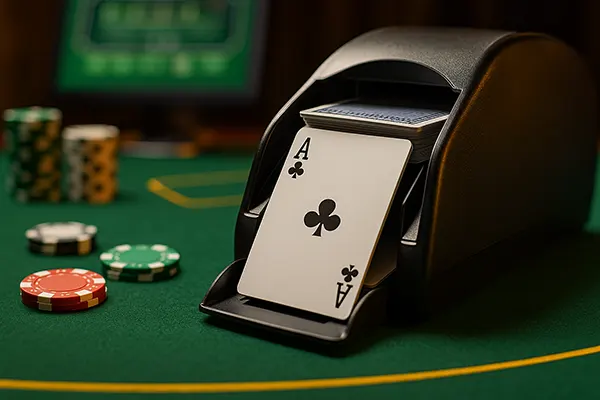
Algorithms Behind Shuffle Bots in Blackjack: How Modern Studios Ensure Fair Card Mixing
Shuffle algorithms used in contemporary blackjack studios have evolved into precise and transparent systems designed to prevent predictable outcomes and eliminate any form of manual interference. By 2025, leading developers rely on cryptographically secure methods, independently audited systems and verifiable procedures to guarantee that every shuffle reflects authentic randomness. These technologies form the technological foundation that ensures the integrity of each round for players worldwide.
The Technology Driving Modern Shuffle Bots
Professional card studios apply advanced randomisation models that simulate the natural disorder of physical shuffling without introducing mechanical imperfections. The foundation of these models is the cryptographically secure random number generator, which creates sequences that cannot be forecasted even with high-level computing resources. This approach prevents any advantage that could arise from analysing card patterns or expected distributions.
In addition to RNG-driven behaviour, developers incorporate adaptive algorithms that continuously monitor their own statistical balance. If the shuffle produces patterns beyond acceptable deviation ranges, the system corrects itself automatically. This safeguard protects players by detecting anomalies that would otherwise be difficult to identify manually.
When implemented in hybrid or live formats, these shuffle bots interact with multiple data points, such as deck size, game speed and the number of active players. Each variable influences the randomisation cycle to ensure the distribution remains unpredictable across all game modes and environmental conditions.
How Studios Validate Shuffle Integrity
To meet strict regulatory expectations, studios allow external laboratories to verify that their shuffle processes conform to international fairness standards. These evaluations include mathematical testing, sequence analysis and long-term simulation designed to reveal hidden biases. Every verified system is issued a conformity certificate confirming compliance with independent testing requirements.
Continuous internal monitoring also plays a significant role. Studios track billions of shuffled hands over extended periods to ensure the system maintains randomness under different workloads. Any irregularities are flagged immediately for review, allowing technicians to adjust or update the algorithm where needed.
By applying both third-party and in-house testing, studios create an environment in which shuffle bots remain accountable, transparent and technically aligned with regulated industry norms. This combined approach reinforces trust in high-volume blackjack environments.
How Cryptography Strengthens Shuffle Bot Accuracy
Certain card studios integrate hash-based cryptographic functions into their shuffle logic, providing additional protection against manipulation. Hash values are generated during each shuffle cycle, creating a mathematical fingerprint that cannot be reverse-engineered. This ensures that neither internal staff nor external actors can influence the card order.
Cryptographic seeds are often drawn from multiple data sources, including entropy pools, server conditions and time-based factors. When combined, these values form a secure starting point for the shuffle, preventing predictable outputs. No single component can be isolated or exploited, as the entire system relies on interdependent calculations.
Some studios also use provably fair methods for hybrid formats, where a public seed is shared with the user. Although more common in peer-to-peer systems, these methods demonstrate how transparency can complement internal safeguards used within regulated blackjack environments.
The Role of Independent Hash Verification
Hash verification offers an additional layer of user-side trust by enabling players to confirm that no alteration took place during the shuffle. Once the round ends, studios release the server seed allowing independent recalculation of the hash. If the result matches the pre-game hash, the shuffle is confirmed as authentic and untouched.
This verification process is widely used in RNG and hybrid blackjack variations because it empowers players to participate in transparency. Even though not all regulated studios apply public-participation models, many began adopting optional verification pathways to align with rising industry expectations.
Cryptographic verification enhances both technical resilience and public confidence. As the blackjack market expands and becomes increasingly competitive, the studios that provide these safeguards gain a clear advantage in terms of reliability and trustworthiness.

Auditing Standards and Regulatory Oversight in 2025
By 2025, auditing procedures for shuffle bots have tightened considerably, driven by the demand for mathematically accurate card distribution across all regulated jurisdictions. Professional auditors deploy simulation software that replicates millions of shuffle cycles to analyse distribution fairness and deviation stability. Systems must pass these tests before they are approved for commercial use.
Regulators also require ongoing compliance checks to ensure that updates or hardware changes do not affect shuffle behaviour. Studios must submit system patches and algorithm revisions for review, ensuring continuous transparency and adherence to technical guidelines. These reviews are documented and stored to track the full update history of each shuffle system.
Independent reports, public compliance notices and regulatory certifications collectively confirm that shuffle bots meet strict operational conditions. This environment enables players to rely on consistently fair card mixing backed by technical oversight, industry governance and verifiable long-term testing.
Why Regular Audits Maintain Modern Standards
Regular audits prevent algorithm drift, a phenomenon where long-term system performance may slowly deviate from expected statistical output. Periodic testing ensures that shuffle patterns remain balanced and that no emerging trend could compromise fairness. This commitment helps maintain the technical precision required for professional blackjack environments.
Many auditors also test algorithms under stress conditions—such as server congestion or increased player activity—to verify that shuffle randomness holds stable under pressure. These simulations mirror real operational scenarios, demonstrating that the system performs reliably across different environments.
With comprehensive, routine auditing, developers and regulators can confirm that shuffle bots continue to meet modern industry standards. This constant supervision reinforces confidence for players and helps maintain fairness as a core principle of contemporary blackjack technology.
-
 Ascending Mount Olympus: An In-depth Look ...
Within the realm of online gaming, ancient myths have often …
-
 Golden Glyph 2 Slot Review: Features, Bonu...
Golden Glyph 2 by Quickspin brings a fresh take on …
-
 Don Juan Peppers by Evoplay — A Festive Me...
Evoplay has introduced a colourful slot called Don Juan Peppers, …
-
 Wild Cash x9990 Slot Review
Wild Cash x9990 is a remarkable addition to the online …