

Wanted Dead or a Wild (Hacksaw Gaming) — Duel at Dawn vs Dead Man’s Hand: A Detailed Comparison of Bonus Scenarios
Wanted Dead or a Wild by Hacksaw Gaming remains one of the most discussed high-volatility slots in 2026. Its reputation is built not only on extreme win potential, but on two fundamentally different bonus mechanics: Duel at Dawn and Dead Man’s Hand. Although both features operate within the same 5×5 grid and share identical symbol values, their mathematical behaviour, risk profile and payout distribution vary significantly. This article provides a clear, practical comparison of these bonus scenarios, focusing on structure, multipliers, volatility patterns and real in-game implications for players who want to understand how each mode truly performs.
Duel at Dawn: Structured Volatility and Controlled Multiplier Growth
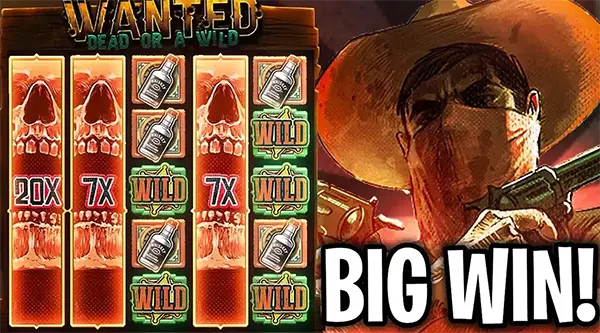
Duel at Dawn is the more structured of the two bonus features. It begins with 10 free spins and introduces one guaranteed VS symbol on every spin. VS symbols split into two multipliers — one applied to the leftmost symbol in the win, the other to the rightmost — creating multiplied line payouts. In Duel at Dawn, only one VS symbol can land per spin, which immediately limits the frequency of compound multiplier stacking.
The key element of this mode is multiplier progression. If a spin produces a win, the next spin’s minimum VS multiplier increases. This progressive floor continues to rise throughout the feature, meaning the bonus becomes more dangerous as it develops. However, because only one VS appears per round, payout spikes are generally tied to symbol quality and multiplier size rather than quantity of modifiers.
In 2026 data reviews and community tracking, Duel at Dawn is widely recognised as the more stable bonus option. It still carries high volatility — the base game RTP remains 96.38% overall — but compared to Dead Man’s Hand, the distribution curve shows fewer zero bonuses and more mid-tier returns. For players seeking slightly more controlled exposure to high multipliers, this mode tends to produce smoother, though still risky, outcomes.
Practical Performance of Duel at Dawn in Real Play
In practical terms, Duel at Dawn often delivers bonuses in the 20x–150x stake range, with occasional jumps well beyond that if multipliers climb and connect with premium symbols. Because the feature restricts VS stacking, extreme five-figure multipliers are rare compared to the alternative bonus, but steady multiplier growth can still generate serious payouts.
Another factor is retriggers. Three or more scatter symbols during the feature award additional spins, giving more time for the multiplier floor to build. When retriggers occur late in the sequence, the increased minimum multiplier can significantly raise expected value per spin, sometimes turning an average start into a strong finish.
Overall, Duel at Dawn rewards patience within the feature itself. It does not rely on chaos. Instead, it gradually amplifies risk through structured multiplier inflation, which creates a measurable and more predictable volatility curve when compared directly with Dead Man’s Hand.
Dead Man’s Hand: Unrestricted VS Symbols and Explosive Potential
Dead Man’s Hand also begins with 10 free spins, but removes the restriction on VS symbol quantity. Multiple VS symbols can appear on the same spin, and each applies dual multipliers. When two or more VS land simultaneously, multipliers stack multiplicatively, not additively, creating the possibility of exponential win scaling.
This structural difference transforms the volatility profile. Unlike Duel at Dawn, there is no guaranteed VS symbol on each spin. That means some spins may produce nothing at all. However, when stacking occurs, the payout potential escalates rapidly. Hacksaw Gaming lists the maximum win for Wanted Dead or a Wild at 12,500x the stake, and the overwhelming majority of documented max wins have occurred within Dead Man’s Hand.
The RTP allocation between bonuses remains the same overall, but Dead Man’s Hand redistributes variance into a far more extreme curve. It produces more zero-return bonuses than Duel at Dawn, yet also generates the majority of four-figure multipliers seen in tracking databases and player reports through 2025–2026.
How Dead Man’s Hand Behaves Under Real Conditions
Dead Man’s Hand is characterised by long dry spells inside the feature, followed by sudden multiplier explosions. A single spin with two VS symbols — for example 10x and 12x on one side, 8x and 15x on the other — can create multipliers in the hundreds before symbol value is even calculated. With premium symbols, this can instantly surpass 1,000x stake.
Because there is no progressive multiplier floor like in Duel at Dawn, the feature’s outcome is highly front-loaded by luck. If early spins miss VS combinations, the bonus can collapse quickly. Conversely, one stacked spin can outperform an entire Duel at Dawn session.
Statistically and behaviourally, Dead Man’s Hand represents pure high-risk volatility. It appeals to players specifically targeting extreme spikes rather than consistent bonus returns. In 2026, it remains the preferred option for those chasing maximum win potential rather than controlled variance.
Direct Comparison: Risk, RTP Behaviour and Strategic Implications
From a mathematical standpoint, both bonuses operate within the same 96.38% theoretical RTP framework, but their variance allocation differs. Duel at Dawn shifts volatility into progressive multiplier scaling, creating steadier bonus averages. Dead Man’s Hand concentrates variance into stacked events, increasing dispersion between outcomes.
In terms of hit frequency within the bonus, Duel at Dawn produces more regular multiplied wins due to the guaranteed VS symbol each spin. Dead Man’s Hand may deliver multiple empty spins in succession. This distinction directly affects perceived value and psychological experience during gameplay.
For players analysing risk in 2026, the choice depends on objective. Duel at Dawn suits those who want exposure to high multipliers with a slightly reduced probability of complete bonus failure. Dead Man’s Hand suits those intentionally targeting the upper tail of the payout distribution, fully accepting higher zero-return frequency in exchange for explosive upside.
Which Bonus Scenario Makes More Sense in 2026?
Market data and player tracking communities consistently show that Duel at Dawn produces more moderate returns across large sample sizes. It does not eliminate volatility, but distributes it more evenly across spins. For bankroll management, this can translate into less dramatic swings over extended sessions.
Dead Man’s Hand, by contrast, dominates highlight reels and maximum win records. Its stacked VS mechanic is responsible for nearly all documented 5,000x+ payouts. However, it also carries a noticeably higher risk of delivering minimal returns.
In practical decision-making, the comparison is not about which feature is better, but which volatility structure aligns with a player’s objective. Both scenarios reflect Hacksaw Gaming’s design philosophy: high risk, transparent mechanics and clearly differentiated bonus logic. Understanding these structural differences is essential for anyone analysing Wanted Dead or a Wild seriously in 2026.
-
 Exploring the Excitement of The Money Men ...
Enter the World of The Money Men Megaways The Money …
-
 How to choose a poker room?
Today, poker is considered one of the most popular card …
-
 Dive Deep with Beast Below: A Comprehensiv...
The world of online slots is vast and varied, offering …
-
 Signs of an Unreliable Online Casino: A Pr...
Choosing an online casino in 2025 is no longer just …