

Why Does Blackjack Insurance Usually Have a Negative Expected Value?
Blackjack insurance may sound like a sensible way to protect your money when the dealer shows an ace. After all, an ace gives the dealer a chance of completing blackjack, which can immediately defeat an ordinary player hand. The problem is that insurance does not actually protect your original stake. It is a separate wager with its own probability of winning, payout and mathematical disadvantage. Although insurance pays 2:1 when successful, the dealer’s chance of holding a ten-value card is normally too low to make that return worthwhile. Understanding this difference helps explain why blackjack insurance usually has a negative expected value, why even-money offers are closely related and why an apparently cautious decision can increase a player’s expected losses over time.
How Blackjack Insurance Works and Why Casinos Offer It
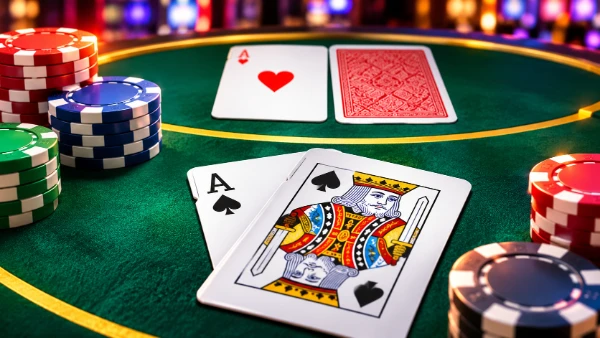
Insurance becomes available when the dealer’s visible card is an ace. In conventional blackjack, an ace combined with a ten, jack, queen or king forms a natural blackjack, the strongest possible starting hand. Because there are four different ranks worth ten points, the dealer has several possible cards that can complete this combination. Before the dealer checks for blackjack, players may be offered an additional wager on whether the hidden card is worth ten. This wager is entirely separate from the original bet and does not depend on whether the player holds a strong hand, a weak hand or blackjack.
The insurance stake is normally limited to half the original blackjack wager. For example, someone who has placed £20 on the main hand can generally insure it for up to £10. If the dealer’s hidden card is worth ten, the insurance bet wins and pays 2:1, providing £20 in profit on the £10 side wager. If the dealer does not have blackjack, the insurance stake is lost and the original hand continues. These terms are standard in many traditional, online and live-dealer blackjack games, although the precise dealing and settlement procedures depend on the rules of the particular table.
The offer can feel reassuring because it appears at a moment when the dealer threatens an immediate win. However, the name is potentially misleading. Ordinary insurance compensates someone for a specified loss, whereas blackjack insurance is simply a prediction about one unseen card. A successful insurance wager may offset the loss of the main stake, but it does not change the cards, improve the original hand or influence the dealer’s result. The casino offers the bet because the advertised payout is normally lower than the mathematically fair return for the probability involved. This difference is the reason insurance can be profitable for the casino even when individual players occasionally benefit from it.
What Happens to Your Money When You Accept Insurance?
Consider a player who places £20 on blackjack and receives a total of 18 while the dealer shows an ace. The player accepts the maximum £10 insurance wager. If the dealer has a ten-value hidden card, the dealer has blackjack and the player loses the original £20. However, the £10 insurance bet produces £20 in profit, so the two results cancel each other out. The player finishes the round with no overall profit or loss, assuming there are no other wagers involved. This is the situation that makes insurance appear particularly attractive: it can turn an immediate £20 defeat into a break-even result.
Now consider the alternative outcome. The dealer’s hidden card is a seven, giving the dealer a starting total of 18 rather than blackjack. The £10 insurance stake is immediately lost, regardless of what happens to the original hand. The player must still compete against the dealer under the normal rules. If both hands finish on 18, the original £20 wager is returned as a push, but the £10 insurance loss remains. If the player wins the main hand, that profit is reduced by the insurance loss. If the player loses, the total loss becomes £30 rather than £20. Insurance therefore introduces an additional financial risk into a round that might otherwise have produced a favourable result.
These examples explain why the outcome of a single hand cannot establish whether insurance is mathematically worthwhile. Winning one insurance bet may save the entire original stake, but losing several insurance bets can gradually consume the profits from successful blackjack hands. The relevant question is not whether the dealer might have blackjack or whether insurance could prevent a particular loss. It is whether the probability of winning the side wager is sufficiently high to justify paying for it. That probability can be calculated from the cards remaining in the game, making insurance a useful example of how an attractive short-term result can conceal an unfavourable long-term expectation.
Why Blackjack Insurance Has a Negative Expected Value
The mathematical disadvantage of insurance comes from the relationship between its payout and the number of ten-value cards available. A standard 52-card deck contains 16 cards worth ten points: four tens, four jacks, four queens and four kings. This means ten-value cards account for 16 of the 52 cards, or approximately 30.77% of a complete deck. Although the exact probability changes as cards are dealt, this proportion provides a useful starting point. Insurance pays a net profit of two units for a successful wager but loses one unit when unsuccessful, so the winning probability must be high enough to compensate for the more frequent losing outcomes.
A 2:1 payout requires a winning probability of exactly one-third, or approximately 33.33%, for the wager to break even. Imagine placing three identical £10 insurance bets in situations where one wins and two lose. The successful wager earns £20, while the two unsuccessful wagers lose £10 each. The combined result is £0. If insurance wins less frequently than once in every three comparable opportunities, the expected return becomes negative. The important difference is therefore between the roughly 31% share of ten-value cards in an ordinary deck and the 33.33% success rate needed for a fair insurance bet.
Expected value describes the average financial result that a wager would produce over a sufficiently large number of comparable opportunities. For insurance, it can be calculated by multiplying the probability of winning by two, then subtracting the probability of losing. Using the approximate full-deck proportion, the calculation is (0.3077 × 2) − (0.6923 × 1), giving approximately −0.0769. In other words, the theoretical expected loss is about 7.69% of the insurance stake under this simplified assumption. This does not mean that every £10 insurance bet loses 77 pence. Individual wagers either win or lose; the percentage describes their average mathematical value across repeated decisions with equivalent probabilities.
Calculating the House Edge in a Six-Deck Blackjack Game
Many blackjack games use several decks rather than one, so a six-deck example provides a more representative illustration of common casino conditions. Six complete decks contain 312 cards, including 96 cards worth ten points. If the only known card is the dealer’s visible ace, there are 311 cards remaining, of which 96 could complete the dealer’s blackjack. The probability of a successful insurance wager is therefore 96 divided by 311, or approximately 30.87%. The remaining 215 cards would cause the insurance bet to lose. This example deliberately ignores the identities of the player’s cards and any other exposed cards, which can alter the actual probability.
Suppose a player repeatedly makes a £10 insurance wager under these same theoretical conditions. Across 311 equivalent opportunities, 96 successful bets would each generate £20 in profit, producing £1,920. The other 215 wagers would each lose £10, creating losses of £2,150. The difference is a negative £230. Dividing that expected loss by 311 gives approximately 74 pence per £10 wager, corresponding to a house edge of about 7.40%. The mathematics does not predict that exactly 96 of the next 311 real insurance bets will win. It demonstrates the average result implied by the specified probabilities and payout. Actual sequences can differ considerably, particularly over a relatively small number of rounds.
The number of decks and the cards already visible can change this calculation. In a single-deck game where only the dealer’s ace is excluded, 16 of the remaining 51 cards are worth ten, giving an insurance success probability of approximately 31.37% and a theoretical house edge of 5.88%. However, a real player also knows their own cards. If a single-deck player holds two non-ten cards, 16 of the 49 unseen cards are worth ten, placing the probability much closer to the break-even point. If the player holds two ten-value cards instead, only 14 of the 49 unseen cards are worth ten, making insurance substantially worse. These examples show why a fixed house-edge percentage is an approximation rather than a universal figure for every individual hand.
When Blackjack Insurance Might Make Sense and What Players Should Know
Insurance is generally an unfavourable choice for someone using ordinary blackjack basic strategy. Basic strategy recommends decisions based on the player’s cards, the dealer’s visible card and the specific table rules, with the aim of minimising the mathematical disadvantage of the main game. Insurance requires a different calculation because it concerns the composition of the remaining cards rather than the relative strength of two hands. A player holding 20 might be especially worried about losing to the dealer’s blackjack, but that strong total does not automatically make insurance worthwhile. Likewise, holding 12 or 16 does not make the side bet more attractive simply because the original hand is weak.
There is an important exception when reliable information indicates that the remaining cards contain an unusually high proportion of tens and picture cards. If more than one-third of the unseen cards have a value of ten, a conventional 2:1 insurance wager has a positive expected value. Card counting can sometimes identify favourable situations of this kind in games where cards are dealt from a shoe without immediate replacement. However, recognising a profitable insurance opportunity requires accurate information about the remaining cards, not merely remembering that several low cards appeared recently. A positive expected value also does not guarantee that the next insurance bet will win, because the dealer’s hidden card remains uncertain.
This distinction matters especially in online blackjack. Some digital games use independently shuffled hands or a freshly generated card sequence for each round, meaning previous results provide no useful information about the next hidden card. Certain live-dealer games use physical shoes and continue dealing through multiple rounds, but their shuffling procedures and available information can differ. In either case, players should consult the actual game rules rather than assume that every version of blackjack behaves identically. Unless there is dependable evidence that ten-value cards make up more than one-third of the relevant unseen cards, the conventional insurance payout remains mathematically unattractive.
Even Money, Common Misconceptions and Sensible Blackjack Decisions
Even money is closely connected to insurance and is commonly offered when a player has a natural blackjack while the dealer shows an ace. At a table where blackjack normally pays 3:2, accepting even money means receiving a guaranteed profit equal to the original stake instead of waiting to see whether the dealer also has blackjack. For example, a £20 natural blackjack would ordinarily produce £30 in profit if the dealer does not have blackjack, while both hands having blackjack would normally result in a push. The even-money offer instead guarantees £20 in profit. This may sound appealing, but in a conventional 3:2 game it is mathematically equivalent to taking maximum insurance on the natural blackjack.
The equivalence becomes clear when the two possible dealer outcomes are compared. Suppose the player has a £20 natural blackjack and places £10 on insurance. If the dealer also has blackjack, the main hand pushes and the insurance wager earns £20, leaving a £20 net profit. If the dealer does not have blackjack, the player’s natural blackjack earns £30, but the £10 insurance stake is lost, again leaving £20. Accepting even money produces the same result without displaying the separate side wager. Declining it preserves the possibility of the full 3:2 blackjack payout, which generally has a higher expected value under ordinary card proportions. Tables paying 6:5 for blackjack have different main-hand returns, so the usual 3:2 equivalence should not be applied to them without checking the rules.
Several misconceptions can make insurance seem more attractive than it really is. One is that a dealer showing an ace is almost certain to have blackjack, even though a ten-value hidden card normally appears less than one-third of the time. Another is that insurance becomes a better choice after a sequence of dealer blackjacks, despite earlier results having no ability to predict independently shuffled future hands. A third is that taking insurance represents careful bankroll management. In reality, repeatedly adding a negative-expectation side wager increases the amount exposed to the casino’s advantage. The practical lesson is straightforward: judge insurance by the probability of a ten-value hidden card and the 2:1 payout, not by the desire to recover a particular hand. For most recreational blackjack players, declining insurance avoids an additional expected loss while leaving the original game to be decided under its normal rules.
-
 Web3 and Gambling: How Smart Contracts Are...
Technological progress is reshaping various industries, and the gambling sector …
-
 How to choose a poker room?
Today, poker is considered one of the most popular card …
-
 Review of the Viking Smash slot from Stake...
Embark on a thrilling journey back to the age of …
-
 La Partage in Different Roulette Versions:...
La Partage is one of the few roulette rules that …